MENU
CH | CHF
-
-
-
- Pichia 2026
- Future Labs Live 2026
- BioProScale Sympposium 2026
- ASGCT 2026
- Eppendorf Automation Forum 2026
- ECB 2026
- WoTS 2026
- ELRIG Drug Discovery 2026
- 75th JAMT Congress & IFBLS2026
- JASIS2026
- ILMAC 2026
- GSCN 2026
- BPI EAST 2026
- Bioprocess Days 2026
- Bioprocess Day 2026, Texas, USA
- Bioprocess Day 2026, Philadelphia, USA
- Cell 2026
- FPP x CMS Amsterdam
-

-
-
-
- Pichia 2026
- Future Labs Live 2026
- BioProScale Sympposium 2026
- ASGCT 2026
- Eppendorf Automation Forum 2026
- ECB 2026
- WoTS 2026
- ELRIG Drug Discovery 2026
- 75th JAMT Congress & IFBLS2026
- JASIS2026
- ILMAC 2026
- GSCN 2026
- BPI EAST 2026
- Bioprocess Days 2026
- Bioprocess Day 2026, Texas, USA
- Bioprocess Day 2026, Philadelphia, USA
- Cell 2026
- FPP x CMS Amsterdam
-
CH | CHF
-
- All Pipettes, Dispensers & Automated Liquid Handlers
- All Micropipettes
- Mechanical Pipettes
- Electronic Pipettes
- Multi-Channel Pipettes
- Positive Displacement Pipettes & Dispensers
- Bottle-Top Dispensers
- Pipette Controllers
- Dispenser & Pipette Accessories
- Automated Pipetting
- Automation Consumables
- Automation Accessories
- Liquid Handler & Pipette Services
Sorry, we couldn't find anything on our website containing your search term.
Sorry, we couldn't find anything on our website containing your search term.

Climate
Read more
Read less
Annabell Methler, Sustainability Manager Climate, explains how important it is for Eppendorf to take countermeasures by simulating CO2 development: "If we continue as before, CO2 emissions would increase significantly in the expected course of business." Nevertheless, CO2 emissions cannot yet be completely avoided at status quo such as for example flights. Eppendorf will offset those remaining greenhouse gases by purchasing so-called CO2 certificates from climate protection projects. "We will continue to look hard for ways to significantly reduce the remaining emissions as well," explains Annabell Methler.
Now we can start full speed ahead toward our goal of zero carbon emissions. We thank everyone in the Eppendorf Group who is working hard to achieve this goal together. Because only if everyone pulls together, the ambition of drastic cutting down the carbon emissions in our own operations by 2028 can become a reality.
Now we can start full speed ahead toward our goal of zero carbon emissions. We thank everyone in the Eppendorf Group who is working hard to achieve this goal together. Because only if everyone pulls together, the ambition of drastic cutting down the carbon emissions in our own operations by 2028 can become a reality.
Read more
Zero Carbon Emissions
The 2015 Paris Climate Agreement, agreed by over 190 countries, limits the global temperature increase to well below 2°C and to continue efforts to limit it to 1.5°C. Industry is one of the largest emissions sectors, accountable for more than 40% of global emissions in 2019. Therefore, industry and business need to contribute achieving the Paris reduction targets.
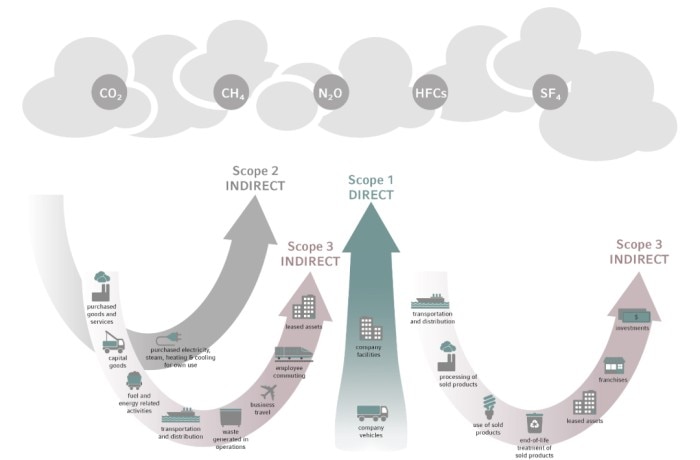
The greenhouse gas (GHG) emissions of companies are captured using the methodology of the Greenhouse Gas Protocol. With this approach, a company's GHG emissions are divided into three categories (scopes 1, 2, and 3).
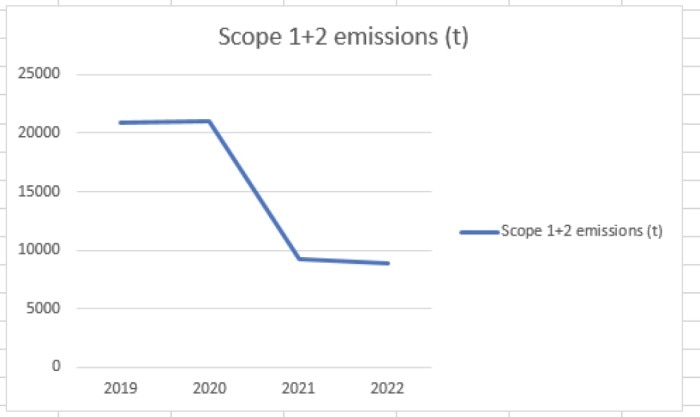
Eppendorf faces up to its responsibility and has clearly mapped the core issue of sustainability in its corporate strategy. To achieve this goal, the Sustainability & HSE team has developed a climate strategy. As part of the overarching Eppendorf sustainability strategy, this concept specifies concrete measures that significantly reduce CO2 emissions. The team developed and coordinated all actions in interviews and workshops with experts and departments. In 2021, Eppendorf sets their first goal: Cut our own emissions as a company down to zero by 2028 with the baseline of 2019. In 2022, Eppendorf already accounted for the GHG emissions of its own organization (thus covering scopes 1 and 2) for the year 2019, resulting in a 58% reduction in emissions since then.
Scope 3 emissions are considerably more challenging to assess as they often lie beyond a company's direct operational control. Scope 3 emissions include upstream and downstream emissions generated by activities such as transportation, raw material usage, and especially the use of sold products like a centrifuge or a freezer. These Scope 3 emissions typically account for over 90% of a company's total emissions in most cases. Eppendorf aims to comprehensively account for all GHG emissions in the future.
Scope 3 emissions are considerably more challenging to assess as they often lie beyond a company's direct operational control. Scope 3 emissions include upstream and downstream emissions generated by activities such as transportation, raw material usage, and especially the use of sold products like a centrifuge or a freezer. These Scope 3 emissions typically account for over 90% of a company's total emissions in most cases. Eppendorf aims to comprehensively account for all GHG emissions in the future.
Read more
What are our steps to reach this target?
- Switch to renewable energy sources at all Eppendorf sites worldwide. We are already using 100% CO2-neutral green electricity at most of our production facilities and in the global headquarters. As a result, CO2 emissions in 2021 were reduced by 57% compared to the previous year.
- High climate standards for new buildings are to be established. The aim is to achieve the so-called DGNB (Deutsche Gesellschaft für Nachhaltiges Bauen) platinum certification, the highest award for sustainable construction for all building developments in Germany.
- Optimizing the energy efficiency of buildings should help to consume less resources.
- By further reducing air freight, transport goods are to be shifted more to rail and sea, resulting in less CO2.
- To gain a low-CO2 vehicle fleet, the entire corporate vehicle fleet will be electrified.
- Environmentally friendly travel will be promoted more strongly.
- We want to benefit more than before from "swarm knowledge" through systematic knowledge development and transfer.
- A competition for climate projects will reward particularly exceptional climate projects.

Carbon emissions scopes
Scope 1: Direct GHG emissions refer to emissions from sources that are
owned or controlled by the company, like the generation of electricity, heat
or steam, transportation of materials, products, employees by company
owned vehicles and to fugitive emissions.
Scope 2: Indirect emissions refer to purchased electricity.
Scope 3: All other indirect GHG emissions which occur in a company’s
value chain, like extraction and production of purchased materials, product
use, disposal of waste, or employee business travel.
SBTi
As a company committed to transparency, we're open about the assumptions and methodologies behind our greenhouse gas inventory. As a science-driven and science-serving company, science-based targets (in line with the goals of the Paris Agreement) and science-based documentation of emissions has been set for us for many years (“science-based approach”).
Since November 2025 we successfully got our validation statement from SBTi. This step marks our ongoing commitment to transparency and progress, ensuring that our next actions are grounded in evidence and focused on creating meaningful impact.
Eppendorf aims to reduce absolute scope 1 and 2 GHG emissions 63.0% by 2035 from a 2023 base year and to reduce absolute scope 3 GHG emissions from purchased goods and services, capital goods and use of sold products 63.0% within the same timeframe.
Our goals
•“Eppendorf Group commits to reduce absolute Scope 1 and 2 emissions by 63% till 2035 from a 2023 base year (in line with 1,5°C)”
•“Eppendorf Group commits to reduce absolute Scope 3.1, 3.2 and 3.11 emissions by 63% till 2035 from a 2023 base year (in line with 1,5°C)”
•“Eppendorf Group commits to reduce absolute Scope 3.1, 3.2 and 3.11 emissions by 63% till 2035 from a 2023 base year (in line with 1,5°C)”
Read more
Scope 3 emissions (model II)
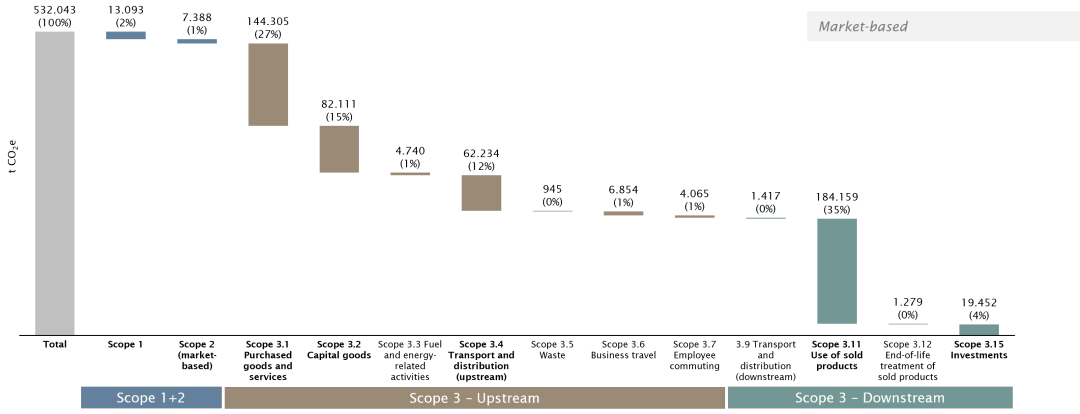
Scope 3 emissions contain the emissions of our suppliers as well as the usage of our final products in the market. The categories 3.1 (raw materials + services of suppliers) + 3.2 (purchased investment goods) + 3.3 (transportation of fuel and gas) + 3.4 (transportation of raw materials to factory) + 3.15 (investments (downstream)) were calculated “spend-based”. This means, the carbon emissions were calculated based on the monetary value of purchased goods or services by a database emission factor (e.g. kg CO2e/ € of value). By this procedure, the supplier part was calculated based on reference data for materials.
Unlike upstream factors, the downstream factors of the categories 3.5 (waste) 3.6 (travel), 3.9 (shipment), 3.11 (usage sold units), 3.12 (sold units end of life) were calculated ”activity-based”. This approach gives us a more precise view of carbon emissions, helping you make informed decisions for a more sustainable future.
The relevant usage phase of our products is limited to electricity-consuming devices like centrifuges, ULT freezers, shakers, or incubators based on different factors:
- 10 years usage of instruments, 250 working days for standard devices, and 365 working days for 24/7 devices like incubators and ULT freezers
- Daily usage pattern of instruments is based on assumptions and calculations by lab-experienced people, supported by calculation methods of My Green Lab® and their ACT® label
- Power consumption per device is primarily based on multiple internal measurements as well as extrapolation within product groups (e.g. not all centrifuge subtypes were measured)
In 2023, the Scope 3 usage emissions reached approximately 510,000 t CO2e. This amount represents about 95% of the total emissions of the Eppendorf Group. Of this, 35% comes from the use of our sold products (Scope 3.11) and represents the largest single value in the calculation. These 184,000 t CO2e are based on a calculation taking into account the continent-specific sales distribution and by this continent specific power grid factors. Reducing these downstream Scope 3 emissions is a significant challenge. The power consumption of the related instruments has very limited saving potentials as heating, cooling, mixing, and spinning are physical processes which require energy. Optimization can be done on small scale but the vast majority of power consumption is set for these products.
It’s also important to note that we have no direct influence over how our products are used or which local power grids supply the energy. It is also important to note that we want to maintain the longevity and durability of our products and further expand and even improve them for an ecological perspective. This, in turn, would lead to a further increase in the emissions category 3.11.These choices are made by the users and the institutions where our products are installed.
Read more